
Wayne County Criminal Docket Searches
The official Wayne County Case Search handles Circuit Court and General Sessions criminal cases. It is the first stop. Pick at least one Court Type. Keep Criminal checked under Case Type. You can search a full party name or an older case reference. A case year works too, as does the last numeric part of a known case number. The form wants its interactive check before Find Now will work.
A bare name can pull back a flood of rows. Pair the name with a likely year or court. After results load, use the sorting and live text filter to narrow them. The portal allows up to 2,500 rows. If nothing comes back, switch the court choice and retry the older reference. A blank public list does not prove that no Wayne County criminal docket exists.
- Open the county search and select Circuit Court, General Sessions, or both.
- Select Criminal and enter a party name, case reference, year, or final case-number digits.
- Complete the page check, run the search, and compare the office, year, style, and number.
- Open the closest match and review its dated events, settings, and disposition.
- Call the Circuit Court Clerk when a record, filed order, or current date cannot be confirmed online.
Wayne Criminal Search Has No Charge Filter
The public form has no charge name, statute, judge, attorney, or filing- and hearing-date fields. That limit shapes any Wayne County criminal docket search. To find a named offense, first pull likely cases by name, year, or number. Then open the record the portal provides. A failed offense search is not a missing case.
Party Name and Case Reference share one box. Search help warns against entering both at once. Full first and last names work best, and quotation marks hold an exact phrase together. Longer terms forgive few typos, and only the first ten search words count. These local rules matter. They often explain why a broad Wayne County criminal case query returns a poor match.
Note: A public search result is an index layer and does not guarantee that every filed image can be opened online.
Criminal Dockets: What They Show
Read a Wayne County criminal court docket as a dated sequence. First match the court office, year, number, and case style. Then follow the initiating event, settings, and motions. The plea or trial event comes next, then judgment, sentence, and later activity. Exact result labels and document links vary, so verify them in the live record itself.
| Case identifier | The year, office, and number or an older case reference. For 99GS1-2023-CR-12345, enter only 12345 in Case Number. |
|---|---|
| Charge | The allegation and any statute or grade shown by the clerk's record. |
| Setting | A dated event such as arraignment, criminal motion, regular docket day, trial, or continuance. |
| Plea and ruling | The formal response and court action, which may occur on different dates. |
| Disposition | The outcome, followed when applicable by judgment, sentence, appeal, or revocation. |
General Sessions Criminal in Wayne County
General Sessions Court in Wayne County takes on misdemeanors, traffic cases, and the early stages of felony matters. In TnCIS it shows up as its own Court Type checkbox. Keep in mind that a criminal docket can start here and later grow into a Circuit Court record, so one office will not hold the whole case path.
The Wayne County Law and Justice page lists court functions at the Criminal Justice Center. For public questions about Circuit or General Sessions court records, call Carol Warren's Circuit Court Clerk office at 931-722-5519. The General Sessions and Juvenile judge office publishes a separate number, 931-722-5563, though it is wise to confirm record routing with the clerk first.
The official General Sessions overview lays out this limited-jurisdiction layer and shows how the court differs from the courts of record above it.
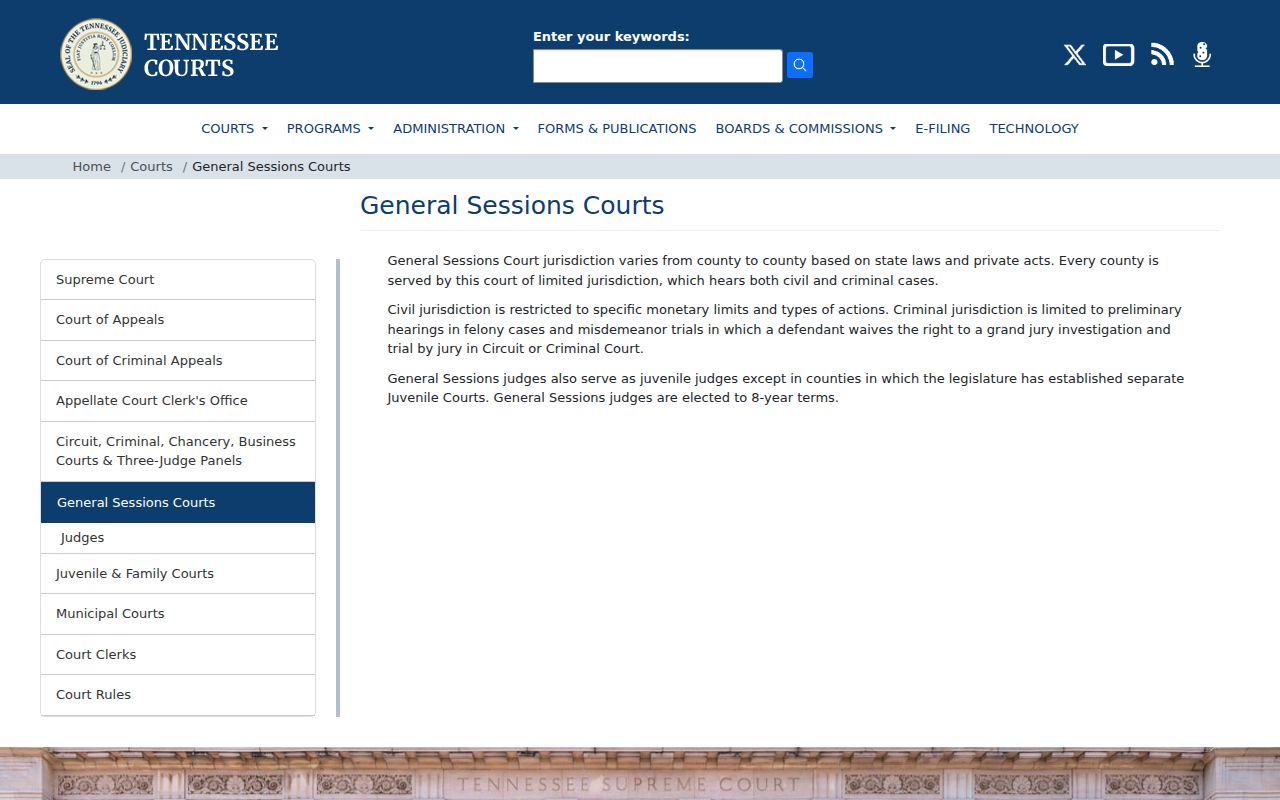
That split matters most when an event trail includes a preliminary hearing, transfer, appeal, or a new Circuit case number.
Criminal Case Stages on the Docket
A Wayne County criminal docket may open with a warrant, complaint, indictment, information, or transfer event. The starting paper depends on the case. Local rules separately cover arraignment, criminal motions, diversion, negotiation or settlement, settings, and continuances. Each step can add an event without ending the case.
Docket flow: Filing › Arraignment › Pretrial › Plea or Trial › Disposition › Sentencing.
Read plea, disposition, and sentence as distinct entries. A plea or verdict is not always the final signed judgment. Later appeal, probation-revocation, bond-forfeiture, or expungement activity can stretch the Wayne County criminal case history on. When the public entry looks brief, ask the Circuit Court Clerk for the filed judgment or order. Do not fill gaps from an event title.
Wayne Criminal Docket Reset Is Not Disposition
The 22nd Judicial District rules address criminal settings and continuances. They also separate two things. One is an order that sets a trial or grants or denies a continuance. The other is an order spread upon the minutes. So a later reset can sit in the court file even while an older notice still shows the prior date. The newest confirmed order controls.
Words like continued, reset, pass, or a new setting describe calendar movement only. They do not mean dismissed, convicted, or closed. Wayne County publishes no official portal code sheet. Check short labels against the event, the filed order, and the clerk's explanation. The Wayne County court schedule lays out the local date confirmation chain.
- Arraignment
- A proceeding that addresses the charge and plea process.
- Continuance
- An order moving a scheduled event to another date.
- Disposition
- The recorded outcome, which differs from a reset.
- Judgment
- The court's signed or entered ruling and sentence.
Wayne County Criminal Docket Courts
Wayne County belongs to Tennessee's 22nd Judicial District along with Giles, Lawrence, and Maury Counties. The Administrative Office of the Courts listing covers three courts. They sit at 1016 Andrew Jackson Drive in Waynesboro. These are the Circuit, Criminal, and Chancery courts. There is no separate Wayne criminal clerk. Criminal docket questions go through the Circuit Court Clerk unless that office points you elsewhere.
General Sessions handles misdemeanors, traffic matters, and preliminary felony hearings. Waynesboro, Clifton, and Collinwood each run municipal courts. Their own clerks hold city citation and ordinance records. The county portal has no municipal checkbox. Juvenile Court sits on its own access path too, apart from an ordinary public criminal docket search.
| Court path | Criminal docket role | First route |
|---|---|---|
| Circuit Court | Trial matters and lower-court appeals | TnCIS, Circuit + Criminal |
| General Sessions | Misdemeanors, traffic, preliminary felony events | TnCIS, Sessions + Criminal |
| City Court | City citations and ordinances | City clerk and citation |
| Juvenile Court | Juvenile proceedings with special rules | Juvenile court office |
Wayne Criminal Records Beyond TnCIS
The public case screen and the filed court record are two different things. Wayne's local e-filing rules draw a line. They separate TnCIS case information from the document system. That system stores electronic or scanned papers. Those rules also define a public-access terminal in the Clerk's Office. That terminal matters when a court record will not fully load through the web search.
You can call the Circuit Court Clerk at 931-722-5519, visit the counter, or mail a focused request to P.O. Box 869, Waynesboro, TN 38485. State the case number, case type, parties, filing year, the exact item wanted, a return address, and whether you need a plain or certified copy. Current countywide copy charges are not published. Ask for the total and the accepted payment method first.
Appeals live in a separate system. Tennessee Public Case History covers three courts. Those are the Supreme Court, the Court of Appeals, and the Court of Criminal Appeals. It may list appeal events and permitted PDFs. Still, it does not replace the Wayne County criminal docket held by the trial clerk.
Access Rules for Criminal Dockets
Ordinary Wayne County criminal court dockets are generally open as court records. Not every file or field is public, though. A sealing order, an expungement, a protective rule, or a statute can hide things. It may hide one document. It may hide the whole case. The portal may also omit an older record or one held by another office. Before reading a no-result search as final, check the spelling, the year, the case reference, the court choice, and the custody status.
Key access rules:
Tennessee Supreme Court Rule 34 recognizes access while preserving sealed, protected, and judicial-function limits.
Tennessee Public Records Act guidance explains citizen inspection rights, procedures, identification, charges, and exemptions.
Juvenile Rule 114 closes dependency and neglect proceedings and permits limits in delinquency and unruly matters.
Never try to bypass a restriction. A party or a lawyer may have a route set by the judge's order. Ask whether the Wayne County criminal record is sealed, expunged, juvenile, archived, or indexed under an older reference.
Confirm Wayne Criminal Documents by Phone
Call before you travel. That matters for a certified judgment, an archived file, or a setting that seems to have moved. The official AOC location pages themselves warn that listings need verification. Wayne's counter hours are not posted. The clerk can tell you where a record sits. It may be in Circuit Court, General Sessions, another clerk's office, or a city court.
For an in-person request, the Circuit Court Clerk works out of 1016 Andrew Jackson Drive, Suite 202, Waynesboro. Ask whether the item is public, scanned, paper, or held somewhere else entirely. A transcript or audio record may sit with the court reporter instead. If you need a certified copy, say so when you ask the price. A portal printout is not automatically certified.
Note: Keep the case number and latest written notice at hand when the clerk checks a Wayne County criminal docket.